


ZME Science
No Result
View All Result
ZME Science
No Result
View All Result
ZME Science

Home → Science → News

Selfies destroy confidence and make young women feel less attractive

Do your self-esteem a favor a dial back on social media.

Tibi PuiubyTibi Puiu
September 6, 2018 - Updated on February 15, 2019
in News, Psychology
A A
Share on FacebookShare on TwitterSubmit to Reddit
Credit: Pixabay.
Credit: Pixabay.

Selfies are a paradoxical millennial fad: everyone seems to hate them but almost everyone takes them. There’s a been a lot of talk in the media about the humble selfie, which was even added to the Oxford dictionary. But are they harmless, or potentially damaging to our psyche, as some studies have suggested?

One recent study found that there may be some reason for concern. According to psychologists at York University in Canada, selfies make women feel “more anxious, less confident, and less physically attractive afterward compared to those in the control group.”

*Snap* I feel awful

More than 95% of college students use social media. Women, however, use it much more frequently than men and have been found to spend more time updating, managing, and maintaining their personal profiles.

Study after study has linked social media use to depression, anxiety, and all sorts of feelings of inadequacies about one’s appearance. But such studies spot correlations, not causal relationships. It could be, for instance, that depressed individuals or those suffering from anxiety spend more time on social media and obsesses more over their online persona than other people.

However, the new study published in the journal Body Image is so carefully designed that it suggests social media really does have a significant influence on a person’s behavior — and not the other way around.

The researchers enlisted 113 Canadian women aged 16-29, who they assigned randomly to one of three different conditions. Each participant was given an iPad, which they used while seated in a private space.

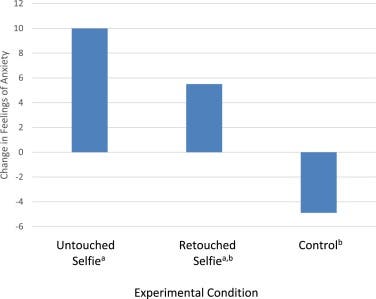
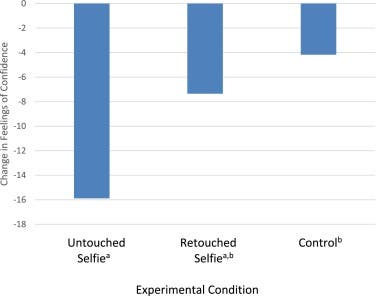
In the “Untouched Selfie” condition, the young women had to take a single photo of themselves and then post it on their Facebook or Instagram profile. In the “Retouched Selfie” group, the participants could take as many selfies as they wished and were also allowed to use a photo editing app before posting their favorite selfie. In the control group, the women were tasked with reading news articles about travel locations. That was it — no selfies, no social media.
RelatedPosts

Meet Meta’s bizarre million-dollar celebrity AI chatbots
Google Earth’s new feature: a timelapse of the entire planet
Japanese device scans a book a minute
Digital Resistance: Ukraine’s social media language shows less Russian and More Ukrainian since invasion started
Mean change in anxiety as a function of condition. Credit: Body Image.
Mean change in confidence as a function of condition. Credit: Body Image.
Mean change in feelings of physical attractiveness as a function of condition. Credit: Body Image.

Women in both selfie-posting groups reported increases in anxiety and feeling less confident than the control group. They also felt less attractive after posting the selfie, regardless of whether or not they could retouch the photo. What’s more, the seemed to be no positive psychological effect following selfie posting on social media.

The main takeaway here is that, for most people, no matter how much we try to put on our best face for social media, it may never feel good enough. The feeling of constant scrutiny can make many people feel inadequate and unconfident about their appearance, as this study shows. So, perhaps those who post too often on Facebook or Instagram might want to dial it back — for the sake of their own’s self-esteem.

“This is the first study to show experimentally that selfie posting on social media is harmful in terms of young women’s mood and self-image. Being able to retouch or modify their photo did not result in women feeling better about themselves after posting a selfie to social media. Future research should look at the longer-term effects of posting photos of oneself on social media, which is an increasingly common aspect of contemporary media use,” the authors of the study concluded.
Tags: selfiesocial media

Share45TweetShare
Tibi Puiu

Tibi Puiu

Tibi is a science journalist and co-founder of ZME Science. He writes mainly about emerging tech, physics, climate, and space. In his spare time, Tibi likes to make weird music on his computer and groom felines. He has a B.Sc in mechanical engineering and an M.Sc in renewable energy systems.

Related Posts

skeleton flower white left and transparent right
Biology

The “Skeleton flower” turns translucent when it comes in contact with water

byAlexandru Micu
2 weeks ago
Future

AI Bots Were Made to Use a Stripped Down Social Network With No Curation Algorithms and They Still Formed Toxic Echo Chambers

byRupendra Brahambhatt
3 weeks ago
Mind & Brain

How Handing Smartphones to Kids Before They Turn 13 May Damage Their Mental Health for Life

byTibi Puiu
2 months ago
Mind & Brain

Selfies are wrong; and also not right

byAdam Taor
2 months ago

Recent news

A 2,300-Year-Old Helmet from the Punic Wars Pulled From the Sea Tells the Story of the Battle That Made Rome an Empire

September 15, 2025

Scientists Hacked the Glue Gun Design to Print Bone Scaffolds Directly into Broken Legs (And It Works)

September 15, 2025

New Type of EV Battery Could Recharge Cars in 15 Minutes

September 15, 2025
  • About
  • Advertise
  • Editorial Policy
  • Privacy Policy and Terms of Use
  • How we review products
  • Contact

© 2007-2025 ZME Science - Not exactly rocket science. All Rights Reserved.

No Result
View All Result
  • Science News
  • Environment
  • Health
  • Space
  • Future
  • Features
    • Natural Sciences
    • Physics
      • Matter and Energy
      • Quantum Mechanics
      • Thermodynamics
    • Chemistry
      • Periodic Table
      • Applied Chemistry
      • Materials
      • Physical Chemistry
    • Biology
      • Anatomy
      • Biochemistry
      • Ecology
      • Genetics
      • Microbiology
      • Plants and Fungi
    • Geology and Paleontology
      • Planet Earth
      • Earth Dynamics
      • Rocks and Minerals
      • Volcanoes
      • Dinosaurs
      • Fossils
    • Animals
      • Mammals
      • Birds
      • Fish
      • Amphibians
      • Reptiles
      • Invertebrates
      • Pets
      • Conservation
      • Animal facts
    • Climate and Weather
      • Climate change
      • Weather and atmosphere
    • Health
      • Drugs
      • Diseases and Conditions
      • Human Body
      • Mind and Brain
      • Food and Nutrition
      • Wellness
    • History and Humanities
      • Anthropology
      • Archaeology
      • History
      • Economics
      • People
      • Sociology
    • Space & Astronomy
      • The Solar System
      • Sun
      • The Moon
      • Planets
      • Asteroids, meteors & comets
      • Astronomy
      • Astrophysics
      • Cosmology
      • Exoplanets & Alien Life
      • Spaceflight and Exploration
    • Technology
      • Computer Science & IT
      • Engineering
      • Inventions
      • Sustainability
      • Renewable Energy
      • Green Living
    • Culture
    • Resources
  • Videos
  • Reviews
  • About Us
    • About
    • The Team
    • Advertise
    • Contribute
    • Editorial policy
    • Privacy Policy
    • Contact

© 2007-2025 ZME Science - Not exactly rocket science. All Rights Reserved.